India patent law follows a structured approach which aims to promote technological innovation but at the same time it impose limits to safeguard public interest, morality, health and national priorities. As a result not every invention or discovery qualifies for patent protection The Patents Act, 1970 prescribes a set of mandatory legal criteria that an invention must satisfy before it can be granted a patent.
Patentability criteria function as a legal filter within the patent system. They help decide whether an invention deserves the grant of a statutory monopoly that allows the patentee to exclude others from making, using, selling or importing the invention for a limited period. This exclusivity is not granted merely as a reward for effort. Instead, it represents a legal tradeoff between private rights and public disclosure.
For this reason, Indian patent law requires that only those inventions which meet defined standards of innovation, technical contribution and social acceptability receive patent protection.
In practice, patentability in India is not assessed solely on the basis of technical novelty or commercial value. The Patent system places considerable emphasis on statutory exclusions, public policy considerations, and ethical limits.
Patentability analysis in India is largely shaped by Sections 2, 3 and 4 of the Patents Act, 1970, read together with judicial interpretation and the examination guidelines issued by the Indian Patent Office. Although the terms “patentability” and “patent eligibility” are sometimes used interchangeably, Indian patent law treats them as conceptually distinct.
What Patentability means under Indian Patent Law
Patentability refers to the legal ability of an invention to be granted a patent under the applicable law. However, in practice, patentability is a multi-layered legal determination, not a single test.
An invention is considered patentable in India only if it:
- Qualifies as an “invention” under Section 2(1)(j) of the Patents Act
- Satisfies the three substantive patentability requirements:
- Novelty
- Inventive Step
- Industrial Applicability
- Does not fall within any of the statutory exclusions specified under:
- Section 3 (What are not inventions)
- Section 4 (Inventions relating to atomic energy)
As a result, even if an invention is new, inventive and industrially applicable, it may still be non-patentable if it is excluded by law.
This layered structure highlights a critical feature of Indian patent law:
Patentability is not only about innovation, but also about legal permissibility.
Policy Objectives behind Patentability Criteria
The patentability criteria under Indian law are deeply rooted in policy considerations. The Indian patent regime does not aim to grant patents indiscriminately but it seeks to:
- Encourage genuine technological advancement
- Prevent monopoly over abstract ideas, natural phenomena or traditional knowledge
- Protect public health, morality and environment
- Ensure access to essential goods and services
- Align innovation incentives with national interest
This can be seen in Section 3 of the Patents Act which excludes a wide range of subject matter from patentability. These exclusions reflect the intent to prevent misuse of patent rights and to ensure that patents serve their true purpose i.e. advancement of science and technology for societal benefit.
The Examiner’s Approach to Patentability in India
Patent examiners assess patentability by strictly applying statutory provisions and examination guidelines.
Patentability analysis typically follows this sequence in examiners perspective:-
- Is the claimed subject matter an “invention” under Section 2(1)(j)?
- Does it satisfy novelty, inventive step and industrial applicability?
- Does the invention fall under any exclusion of Section 3 or Section 4?
- Is the specification clear, enabling and sufficiently disclosed?
Many patent applications are refused primarily because they fall within the exclusions listed under Patent act so a proper understanding of patentability in India is incomplete without a detailed examination of these statutory exclusions.
Role of Section 3 in Determining Patentability
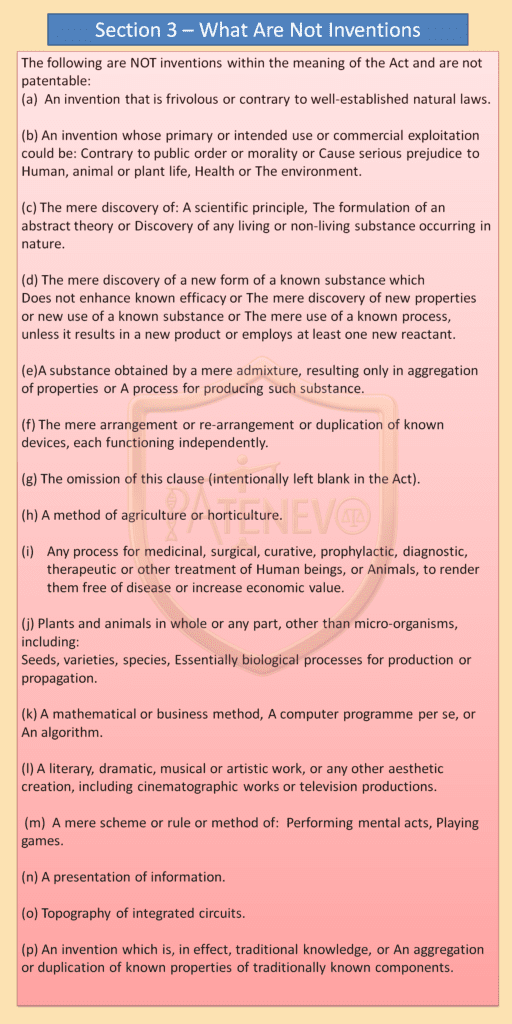
Section 3 of the Patents Act, 1970 enumerates categories of subject matter that are expressly declared “not inventions” within the meaning of the Act which is one of the most common ground on which patent applications are refused in India.
These exclusions cover, among others:
- Frivolous inventions
- Discoveries of natural phenomena
- Abstract theories and mathematical methods
- Methods of agriculture and horticulture
- Medical and surgical treatment methods
- Computer programs per se
- Mere admixtures without synergistic effect
- Traditional knowledge and aggregation of known properties
The purpose of Section 3 is not to discourage innovation but to ensure that patents are granted only for genuine technical contributions and not for discoveries, ideas or activities that should remain in the public domain.
Section 4 and National Interest Considerations
Section 4 of the Patents Act provides that no patent shall be granted for an invention relating to atomic energy, as defined under the Atomic Energy Act, 1962.
This provision reflects the State’s sovereign control over sensitive technologies that have implications for:
- National security
- Public safety
- Strategic interests
Section 3 addresses a wide range of subject matter exclusions while Section 4 is narrow but absolute in nature. Any invention that relates to atomic energy is automatically excluded from patent protection in India.
Importance of Section 3 and 4 in Patent Strategy
From a practical filing perspective Sections 3 and 4 play a decisive role in patent drafting, prosecution and enforcement strategy in India.
Applicants must:
- Evaluate patentability before filing
- Draft claims that avoid statutory exclusions
- Anticipate examiner objections under Section 3
- Provide technical explanations that demonstrate how the invention goes beyond excluded subject matter
Failure to consider these provisions at an early stage often results in:
- Examination reports with multiple objections
- Repeated amendments
- Refusal of applications
- Loss of time and resources
Therefore, understanding patentability criteria particularly the exclusions under Sections 3 and 4 are important. It is a practical necessity for anyone seeking patent protection in India.
Judicial Interpretation and Patentability
Courts have repeatedly emphasized that patentability must be assessed strictly in accordance with statutory provisions. Judicial decisions have clarified that:
- Patent rights are statutory privileges, not natural rights
- Courts cannot extend patent protection beyond legislative intent
- Section 3 exclusions must be interpreted purposively
Case law has played a vital role in shaping the contours of patentability, especially in areas such as:
- Pharmaceutical inventions
- Incremental innovations
- Software-related inventions
- Traditional knowledge
Hence patentability is a dynamic concept, evolving through legislation, administrative practice and judicial interpretation.
Patentability as a legal filter under Indian Patent Law
Patentability Criteria function as a gate keeping mechanism ensuring that:
- Only deserving inventions receive patent protection
- Public domain knowledge remains free and accessible
- Innovation incentives do not override ethical, social or national concerns
Sections 3 and 4, in particular, embody this gate keeping role by drawing clear legal boundaries around what can and cannot be patented in India.
Statutory Exclusions from Patentability under Sections 3 and 4 of the Patents Act, 1970